In the mid-1990’s I worked as a photoshop jockey for the Sydney Morning Herald and other Fairfax Media newspapers. At that time we would regularly send a photographer into the field with a large Pelican case that held a digital field kit.
The kit consisted of a maxed out Powerbook 180 (Greyscale 9.8″ screen, 14MB RAM, 33MHz M68030 CPU, 56.7kbps modem) and a Nikon LS-1000 film scanner with associated cables and power supplies. The kit allowed a photographer to shoot film, process the film at a local mini-lab in the field, scan the images, and transfer them to the newspaper office. In practice this allowed comparatively rather rapid delivery of photos into the editorial process.
During my work on LTFS I messed around with a bunch of side projects on the periphery of LTFS. In one of these projects tried to devise a portable system that would support LTFS. My thinking was largely modeled on my earlier experience with the Powerbook-based field kit. I wanted to be able to give someone a portable box that could be used with a laptop and a digital camera that could be used as a videographer field unit. My idea was something that could be carried to any location, would be easy to set up, and allowed the user to dump content onto LTFS tapes and FedEx the tapes back to home base.
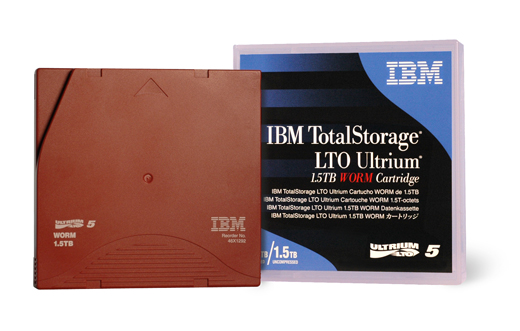
As a demonstration unit I assembled an enclosure that held a LTO5 drive, a SAS HBA, and a PCIe to ExpressCard bridge. This enclosure ended up having the footprint of a 15″ Powerbook and was a little taller than a LTO half-high drive. I showed the demo unit at several trade shows and other public events we did for LTFS.
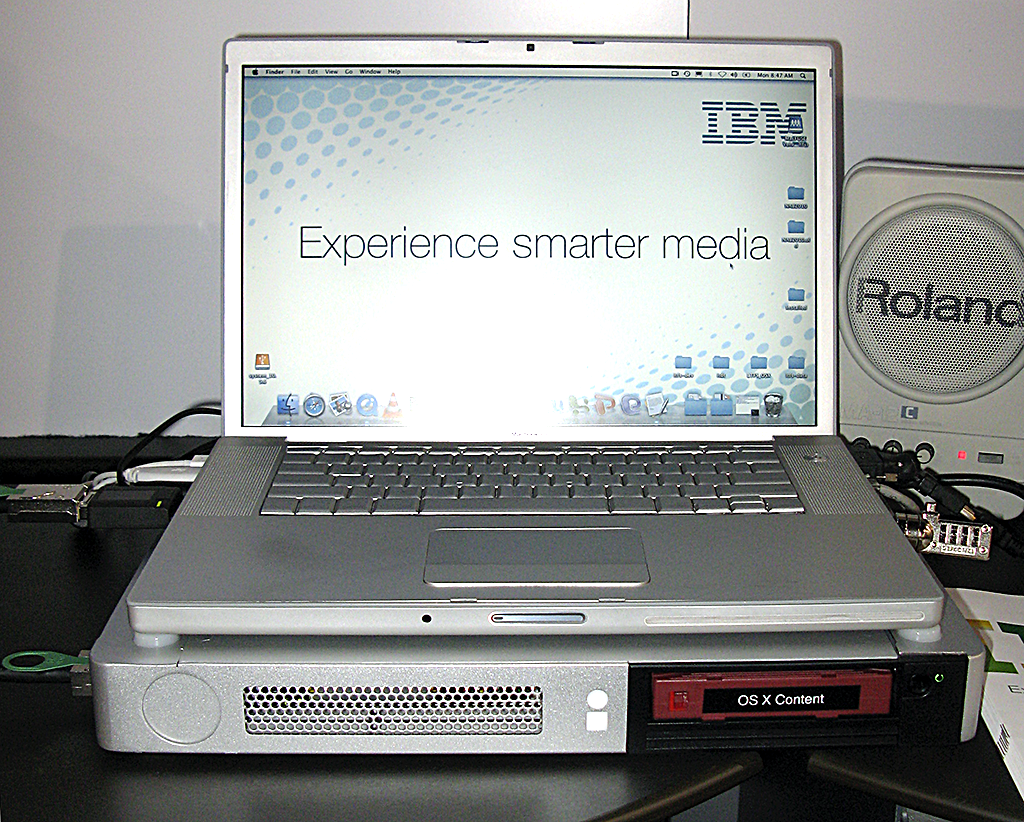 LTO/LTFS portable drive at NAB 2010
While refining this portable LTFS box I played with a few different ExpressCard->PCIe bridges and some early thunderbolt->PCIe bridges. A recent question on the Mac Enterprise mailing list asked:
“One route is to go with a TB to PCI chassis then SCSI card to LTO but what little I have found says this is not reliable. Ditto TB to SAS then to SAS LTO. Anyone have any experience with setups like this and with what software?
Tape is pretty much a given. This is a situation where people need to be able to go back in time and pick up a file or folder state from 3 months ago.”
My work building this LTFS portable drive provided me with somewhat relevant experience. My answer to the mailing list may be useful for a broader audience so I’ve included it below:
My experience using both thunderbolt->PCIe and ExpressCard->PCIe bridges has largely been successful. I used the bridges with both SAS and Fibre Channel HBAs to connect LTO4 and LTO5 drives to a few different OS X machines (and some Dell and Lenovo systems). In all cases I found the ExpressCard/Thunderbolt->PCIe bridges reliable.
The few problems I encountered were always traced back to the HBAs and/or LTO drive not supporting or recognizing various sleep state events. (Or OS X not reinitializing the bus after waking up from sleep which amounts to the same thing.)
Fortunately working around this sleep issue is trivial. Just disable system sleep. Allow the monitor to go to sleep if you like, but ensure that the OS X system does not sleep.
If you are going with LTO tape in the scenario you briefly describe, you will need to work out how you want to handle the file meta-data. (Filename, timestamps, folders, permissions, etc.) Traditional tape systems maintain separate parallel databases to hold the metadata. This works, but if the database gets corrupted then all of your tapes suddenly hold garbage.
A more recent approach that is possible with LTO5 and LTO6 is to use LTFS. LTFS is a POSIX-compliant filesystem that uses LTO tape as the primary filesystem datastore. This means the file meta-data is stored on the tape right alongside the file content. As a result, the tape is self-contained and can be mounted exactly like a USB drive can be mounted. Data can be added to the LTFS volume by dragging and dropping files. Restoring data is also a drag and drop operation.
Alternatively, since LTFS is POSIX compliant applications can seek to any byte offset within a file in LTFS. In comparison, traditional systems require a parallel database, or a packaging format like “tar”. Packaging formats typically require an extensive tape traverse during restore. Whereas LTFS supports a direct seek to the data being accessed. LTFS also provides file-system versioning baked into the filesystem. The file-system versioning might be of use in your scenario.
The implementation of LTFS for OS X, Linux, and Windows is free for single tape-drive operation.